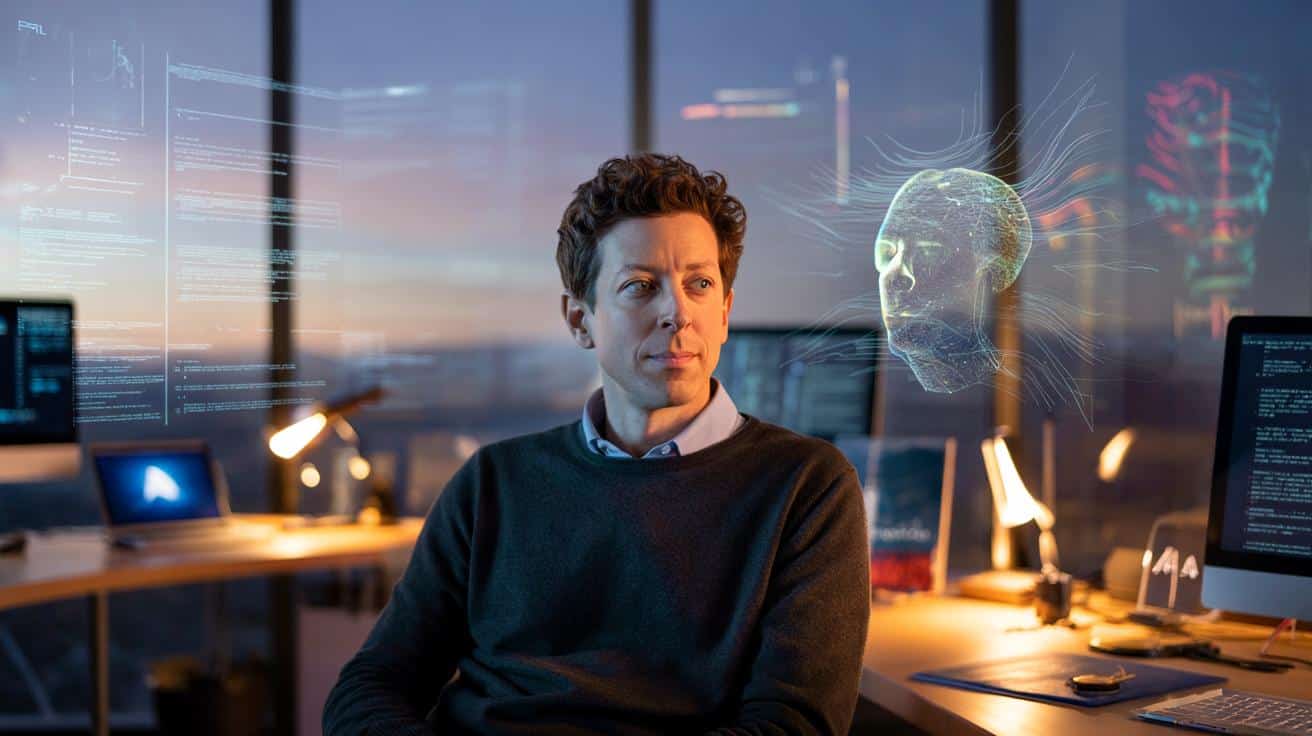
While ChatGPT has become a household name almost overnight, the story of the person behind it is less familiar. Sam Altman, once a shy computer-obsessed teenager, now sits at the centre of a heated global debate about how far artificial intelligence should go, and who gets to control it.
From Chicago childhood to Silicon Valley experimenter
Sam Altman was born in 1985 in Chicago and grew up in a comfortable, tech-friendly environment. Family stories often mention him disassembling household electronics just to see how they worked.
By the age of eight, he could take apart a computer, rebuild it and change how it behaved. That early hands-on approach shaped his relationship with technology: not as something magical and distant, but as a puzzle he could rewire.
During his teenage years, Altman taught himself to code. While other kids were focused on exams or sports, he was diving into programming languages and online forums. That curiosity would later give him the confidence to question how software should be built and who it should serve.
Stanford dropout with a start-up obsession
Altman briefly studied computer science at Stanford University. Like many future tech founders, he didn’t stay long. The promise of building something real attracted him more than finishing a degree.
At 19, he co-founded Loopt, a location-sharing app for smartphones. The idea was simple: let users choose which friends could see their position in real time. It was an early attempt at what is now routine on apps like Find My Friends, WhatsApp and Snapchat.
Loopt never became a massive consumer hit, but it opened an important door: the company joined Y Combinator, then an emerging start-up accelerator in Silicon Valley. That single step pulled Altman into the heart of the US tech ecosystem.
The Y Combinator years: from founder to kingmaker
After Loopt’s sale, Altman shifted roles. In 2014, he became president of Y Combinator, which by then had already backed hits such as Airbnb and Dropbox. Altman expanded its ambitions, encouraging bets on harder, more ambitious technologies.
At Y Combinator, Altman moved from building one product to influencing the direction of dozens of future tech giants.
➡️ So bereiten Sie gesunde Snacks zu, die Heißhunger stoppen
➡️ Genialer Trick: Mit diesen Küchenresten locken Sie jeden Morgen Rotkehlchen in Ihren Garten
➡️ Warum dein Körper im Januar langsamer ist und wie du das sinnvoll nutzt
➡️ How to choose the right poultry for Christmas? The expert tips of Raphaël Gruman
➡️ A giant find under the desert could upend the global nuclear race
➡️ If you want beautiful apples, this step is indispensable starting today
In that position, he saw patterns: why some founders succeeded, why others stalled, and how trends like cloud computing and mobile were reshaping behaviour. Those lessons were crucial when he later turned to artificial intelligence.
- Loopt gave him firsthand experience of building and scaling a start-up.
- Y Combinator exposed him to thousands of founders and ideas.
- Both roles sharpened his instincts about timing and technological shifts.
The birth of OpenAI: from idealism to hybrid model
In December 2015, Altman joined forces with Elon Musk, Greg Brockman, Ilya Sutskever and several other researchers and entrepreneurs to create OpenAI. The original pitch was ambitious: an independent research lab aiming to build artificial general intelligence (AGI) that would benefit humanity as a whole, not just a few corporations.
OpenAI started as a non-profit, a rare choice in Silicon Valley. The founders framed it as a counterweight to Big Tech, promising to share research and keep the focus on safety and broad access.
As AI models grew larger, the costs exploded. Training state-of-the-art systems began to require giant data centres, specialist hardware and vast amounts of energy. Under Altman’s leadership, OpenAI reshaped itself into a “capped profit” hybrid structure. The idea: allow investors to earn up to a limit, while keeping a non-profit entity in charge of long-term goals.
OpenAI’s hybrid structure reflects a tension at the heart of modern AI: huge public impact, but enormous private costs.
This shift let Altman raise billions of dollars for computing power and research, while still claiming to guard against unrestrained profit-seeking. Critics question how strong those limits really are, but without that funding, today’s large models would likely not exist in their current form.
Building the engines: GPT, DALL·E and Sora
Once in charge of OpenAI’s day-to-day direction, Altman pushed hard on large language models (LLMs) and generative systems. These models use a “transformer” architecture, a deep learning design that can handle massive amounts of text, images or video.
OpenAI’s GPT series of models became the backbone of its products. GPT systems are trained on huge collections of text and code so they can predict the next word in a sequence. With enough training, that simple task becomes surprisingly powerful, allowing the model to answer questions, write essays, summarise reports or imitate styles.
Alongside text, OpenAI built generative image and video models such as DALL·E and Sora. These tools can create visuals from natural language prompts, blurring the line between human creativity and algorithmic synthesis.
Key OpenAI projects under Sam Altman
| Project | Main function | Typical use cases |
|---|---|---|
| GPT models (including GPT-4o) | Generate and understand text | Writing, coding help, translation, analysis |
| DALL·E | Create images from prompts | Design drafts, marketing visuals, concept art |
| Sora | Generate video from text | Storyboards, advertising clips, visual concepts |
The ChatGPT moment: AI goes mainstream
In late 2022, OpenAI quietly launched a web interface called ChatGPT, built on its GPT architecture. The product looked simple: a chat box where users could ask questions and get conversational answers.
Behind that simplicity sat years of research, billions of training examples and an immense computing backend. ChatGPT could answer trivia, write essays, draft emails, create poems, debug code and generate images, all through plain language.
ChatGPT turned obscure AI research into a daily habit for students, office workers, freelancers and grandparents alike.
The growth stunned even seasoned observers. Within weeks, tens of millions of users had tried it. Within months, it became one of the fastest-growing services in internet history. OpenAI now speaks of hundreds of millions of monthly users, with businesses integrating the technology into customer service, document analysis and creative workflows.
For many people, ChatGPT was the first time AI felt tangible and useful, not just a buzzword in a conference keynote. That visibility also brought scrutiny: fears over job losses, misinformation, privacy and the concentration of power in a few companies.
Racing toward artificial general intelligence
Altman speaks openly about aiming for AGI, a level of AI that can perform most tasks a human can, potentially at greater speed and scale. OpenAI’s official mission is anchored around this concept, framing AGI as both an opportunity and a risk.
Current models like GPT-4o still make mistakes, “hallucinate” facts and misunderstand context. Yet their rapid progress over just three years has raised the stakes. A tool that once looked like a novelty is now handling legal drafts, code reviews and medical summaries.
Altman continues to steer OpenAI towards models with stronger reasoning abilities and more autonomy. That includes agents that can plan steps, call external tools and operate over long periods to complete complex tasks.
What generative AI actually does
Generative AI systems like ChatGPT don’t “think” in a human sense. They predict patterns based on what they have seen in their training data. When you ask a question, the model guesses the most likely sequence of words to respond with, given everything it has absorbed.
This can be extremely helpful in structured environments, such as summarising long reports, drafting emails or proposing code snippets. It becomes less reliable where factual precision, originality or fresh data are crucial. Understanding that difference helps people use these tools wisely.
Everyday impacts: jobs, skills and new habits
For workers, Altman’s products have become both a shortcut and a source of anxiety. An AI system that writes passable first drafts can save hours, but it also raises questions about who gets hired for writing or support roles.
In offices, ChatGPT is used to prepare slide outlines, clean up meeting notes and generate marketing copy. Teachers debate whether students using it to draft essays are cheating or just adapting to a new calculator-like tool. Programmers lean on GPT-style models for boilerplate code and debugging suggestions.
Many early adopters treat ChatGPT less as a replacement and more as a junior assistant that never sleeps.
That shift nudges people toward different skills: clearer prompting, sharper editing, stronger critical thinking. The value often sits in knowing what to ask for and how to judge the answer, not in typing every word from scratch.
Risks, safeguards and the pace of change
Altman has repeatedly called for some form of AI regulation, especially for the most capable systems. He argues that governments should set rules around safety tests, misuse and concentration of power, even as OpenAI races forward with new releases.
Critics argue that relying on the same companies building the technology to shape the rules is risky. They worry about bias in training data, surveillance possibilities, deepfakes and the impact on democratic processes. The tension between rapid innovation and careful oversight runs through almost every public appearance Altman makes.
For ordinary users and businesses, a few practical habits can reduce risk:
- Treat AI-generated content as a draft, not a final verdict.
- Double-check facts, especially on sensitive topics.
- Avoid sharing confidential information in prompts.
- Use AI as a support tool alongside human judgement.
Key terms and future scenarios
Several concepts around Altman’s work often cause confusion. A start-up usually refers to a young company trying to grow quickly with a scalable product. An accelerator, like Y Combinator, gives such companies funding, mentoring and visibility in exchange for equity.
Generative AI describes systems that create new content—text, images, audio or video—based on patterns first learned from large datasets. A language model is a specific type of generative AI focused on text and code.
Looking ahead a few years, one realistic scenario is a workplace where AI tools are woven into nearly every digital task. A lawyer might use a model to sift through case law, a doctor might rely on summarised patient histories, and a small business owner might automate admin and customer emails with a few well-crafted prompts.
Another scenario, often raised by Altman himself, is the arrival of truly general systems that can outperform humans at most cognitive tasks. That could unlock massive productivity gains, but also create turbulence in labour markets and raise hard questions about control, governance and access.
For now, Sam Altman remains a central, sometimes divisive figure: celebrated as a builder of powerful new tools, challenged as a gatekeeper of unprecedented influence. ChatGPT may be the product, but his choices continue to shape how far generative AI will go—and who benefits from its rise.