While branches still seem lifeless and the ground stays cold, apple trees are already preparing their next season. What you do with them now, at the tail end of winter, can mean the difference between a handful of small, disappointing apples and baskets of firm, juicy fruit.
Why late winter quietly decides your autumn apple harvest
Apple trees in February look dormant, but they are in a crucial phase. The sap has retreated into the roots to protect the tree from frost. Growth above ground appears frozen in time, yet this resting period is exactly when you can safely intervene.
Working on your trees before temperatures climb and sap rises again changes how the tree allocates its energy. If you act now, the tree will channel strength into flower buds rather than into long, leafy branches that look impressive but carry little fruit.
Late winter pruning is less about appearance and more about redirecting energy from wood to fruit.
The key technique is called fruiting pruning. Unlike a quick cosmetic trim, fruiting pruning is a deliberate way of guiding sap, light and air through the tree. For home gardeners, it is the single most effective winter gesture to improve both the quality and quantity of apples.
Before you cut: tools, hygiene and a slow 360° look
Good pruning starts long before the blades touch the bark. Blunt or dirty tools can cause ragged wounds and spread disease from one tree to the next.
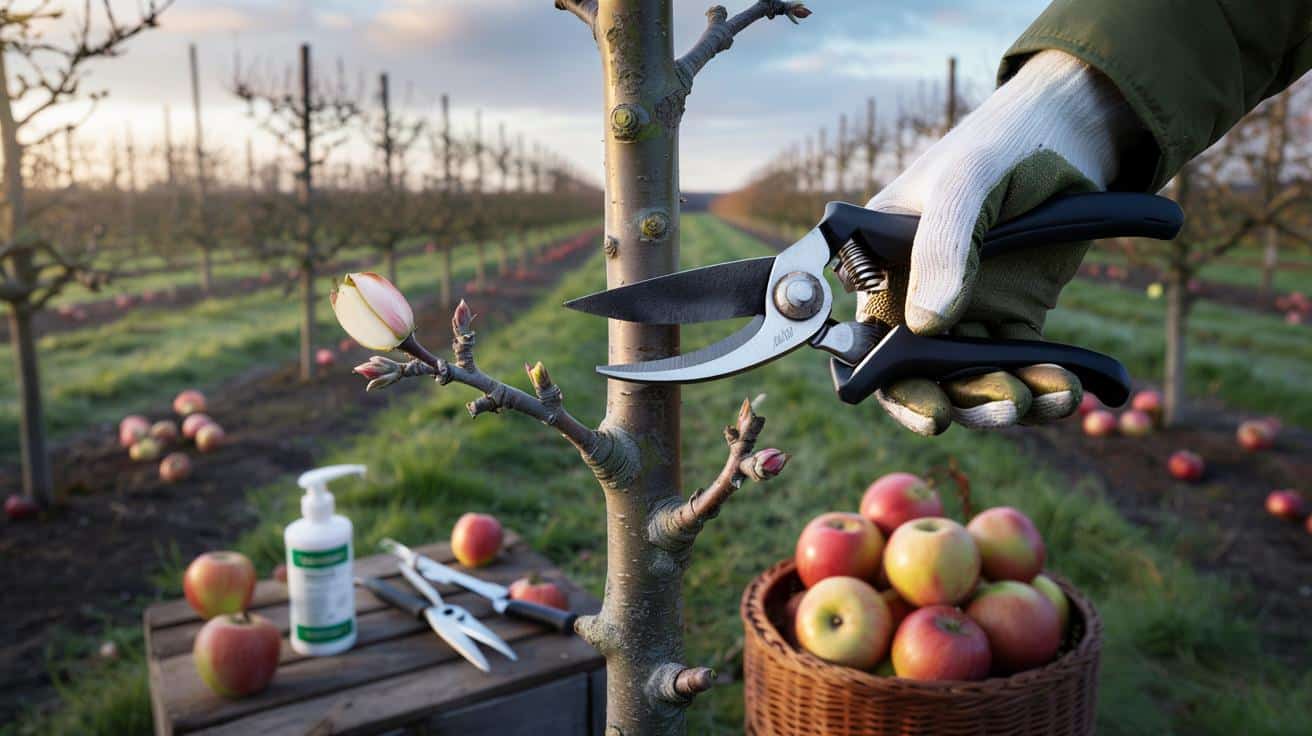
The bare minimum kit for apple tree pruning
- Bypass secateurs for small to medium branches, sharpened so they slice cleanly.
- Lopper or branch cutter for thicker wood that needs more leverage.
- Disinfectant or high-strength alcohol to wipe blades between trees.
Cleaning blades takes a few seconds and can spare you years of trouble with canker, fungal infections, or virus spread across the orchard.
Sharp, disinfected tools are your first line of defence against disease and slow healing.
Once equipped, resist the urge to prune straight away. Walk slowly around the tree. Look at its overall shape. Identify branches that cross, rub or grow towards the centre. Dense, tangled centres trap moisture and shade, which encourages disease and produces small, poorly coloured fruit.
➡️ Leclerc: Michel-Édouard Leclerc warnt Kunden vor einer schlechten Nachricht
➡️ So entfernen Sie Kaugummi von Textilien mit Essig und sparen teure Reinigungsdienste, einfach
➡️ Get ready: in 2026, generative AI shifts into a higher gear
➡️ Diese einfache Regel beim Online-Einkauf verhindert spontane Fehlkäufe
➡️ A giant find under the desert could upend the global nuclear race
➡️ Genialer Trick: Mit diesen Küchenresten locken Sie jeden Morgen Rotkehlchen in Ihren Garten
Your aim is a structure where light and air can reach throughout the canopy. Visualise the tree in full leaf: where will sunlight struggle to penetrate? Those are the areas to open up.
The core technique: using the “three-bud rule” to boost fruiting
Fruiting pruning seeks balance. You are not trying to shrink the tree dramatically, nor to leave it untouched. You are guiding its architecture.
Focus on the lateral branches that grow from the main framework of the tree. By shortening these, you concentrate sap closer to the trunk, where it best nourishes buds that will become flowers, then apples.
How the three-bud rule works in practice
Gardeners often rely on a simple approach known as the three-bud rule:
This method does two crucial things:
- Concentrates sap on fewer buds, making them more likely to form flower buds and fruit spurs.
- Directs growth outward rather than back into the centre, which helps keep the canopy airy and sunlit.
Cut just above an outward-facing bud so future growth opens the tree, instead of crowding its centre.
Always cut at a slight angle, sloping away from the bud you are keeping. Leave a small margin above the bud so it is not damaged, but do not leave a long stub, which can rot and harbour disease.
Common pruning mistakes that quietly sabotage your apples
Many gardeners hesitate, worried about harming the tree, or they swing to the other extreme and cut back too harshly. Both reactions create problems.
Not pruning at all
Skipping pruning might feel “safer” for beginners, yet it exhausts the tree over time. Energy flows into long, unproductive wood. The result: lots of leafy branches, fewer flowers, and sparse, small apples.
Cutting too hard, too fast
Heavy-handed pruning pushes the tree into survival mode. Instead of fruiting, it produces vigorous vertical shoots, often called water sprouts or “suckers”. These use up energy and create a dense thicket in the upper canopy, worsening shade and making future pruning more complicated.
Bad cuts, bad angles
Flat cuts above a bud catch water. That moisture lingers, increasing the risk of rot and fungal disease. Ragged cuts from dull blades heal slowly and invite infection.
Each cut should be clean, angled, and deliberate. Guesswork with a blunt blade is where most damage starts.
Helping the tree heal: from fresh wounds to future blossom
Once you finish pruning, the tree carries multiple wounds. On small cuts, the bark can seal naturally. On larger cuts – anything wider than roughly two to three centimetres – the risk of infection grows.
Many growers use a wound sealant or tree dressing, often based on pine tar or clay, to cover big cuts. This product helps shield exposed wood from spores, pests and excessive moisture while the tree forms its own protective tissue.
The final job is on the ground, not in the branches. Collect all pruned material beneath the tree:
- Healthy branches can be chipped and added to compost or used as mulch once broken down.
- Infected wood showing canker, discolouration or odd growths should be removed from the site to avoid reinfection.
What actually happens inside the tree after pruning?
Pruning does not just change the tree’s shape; it rewrites its internal priorities. When you remove wood, you change the balance between roots and canopy. After cutting, the root system suddenly supports fewer buds and branches, so each remaining bud can receive more resources.
This shift often encourages the formation of fruiting spurs – short, stubby branches that carry blossom year after year. By repeating careful late-winter pruning over several seasons, you build a network of these spurs, which leads to more regular and reliable harvests.
| Action | Short-term effect | Impact on future fruit |
|---|---|---|
| No pruning | Dense growth, shaded centre | Few, smaller apples; higher disease risk |
| Light, targeted pruning | Balanced structure, good airflow | Better fruit size, colour and flavour |
| Severe pruning | Strong vertical shoots, stressed tree | Delayed fruiting, irregular harvests |
Extra tips for different gardens and climates
Not every orchard looks like a picture in a textbook. Small gardens, containers and different climates all need slight adjustments.
For small gardens and patio trees
Dwarf or patio apple trees respond well to the same principles, just on a smaller scale. Keep the central area open, shorten laterals to three buds, remove crossing branches, and check that the tree stays within a size you can safely reach without ladders.
In colder or wetter regions
In very cold areas, pruning is often done toward late winter rather than early, so fresh cuts are not exposed to the harshest frosts. In wet climates, good airflow is even more critical, as damp foliage favours scab and other fungal diseases. Cutting for light and ventilation becomes a health measure as much as a fruiting strategy.
Jargon decoded: buds, spurs and “gourmands”
Pruning advice often uses terms that sound technical but describe simple realities on the branch.
- Vegetative bud: slim, pointed bud that usually produces leaves and shoots.
- Flower bud: rounder, plumper bud that opens into blossom, then fruit.
- Fruiting spur: short, thickened side shoot carrying flower buds year after year.
- Water sprout or gourmand: very vigorous, upright shoot that grows fast but rarely fruits.
When you stand under your tree with secateurs in hand, look carefully at bud shape. Over time, learning to read the difference between leaf buds and flower buds helps you judge how hard you can prune without cutting away too much of your future crop.
Imagine two scenarios next autumn: one tree left untouched, tangled and shaded, another shaped thoughtfully during a cold February morning. The second tree will usually offer fewer but larger and better-coloured apples at first, then, as spurs build up, generous crops year after year. That quiet winter gesture – sharp blades, a few decisive cuts and a little patience – is what makes those future apples worth biting into.