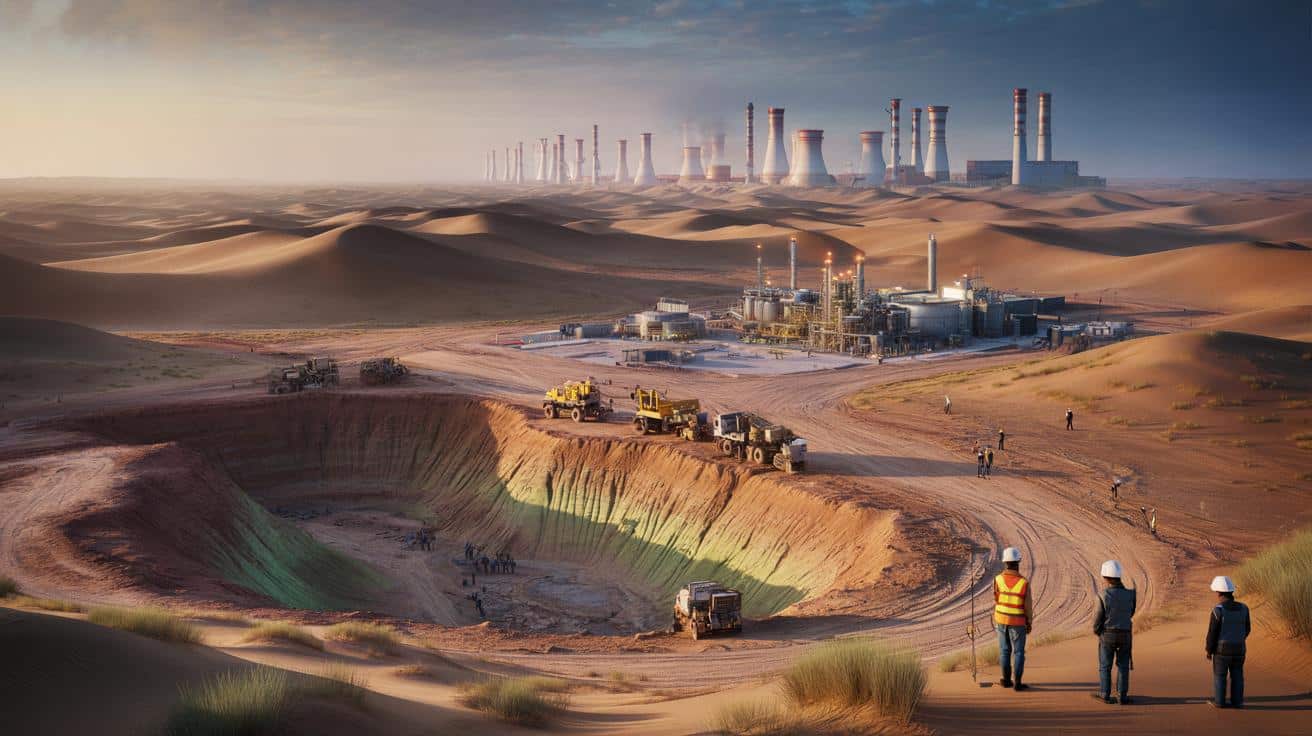
Chinese authorities have revealed the presence of a vast uranium deposit hidden under the Ordos Desert in Inner Mongolia, hinting at a shift in both Beijing’s energy ambitions and the balance of power in the nuclear fuel market. Analysts are now asking whether this single site could give China decades of strategic leverage in the race to secure low‑carbon energy.
A buried giant beneath the sands
The Ordos Desert is a harsh landscape: sandstorms, freezing winters, scorching summers. For years, it was better known for coal and wind farms than anything else. That may now change.
Chinese geologists report that the region contains a colossal uranium deposit, estimated at around 30 million tonnes of ore. If the figures hold, it would rank among the largest known uranium resources on the planet.
Hidden under the dunes, the Ordos field could give China a long‑term domestic supply of nuclear fuel on a scale rarely seen.
The discovery comes as China rapidly expands its nuclear power fleet as part of its strategy to curb coal use, stabilise electricity supply, and cut greenhouse gas emissions. Access to a large, local uranium source gives Beijing more room to plan long‑term and depend less on imports from politically sensitive regions.
Why this matters for nuclear power
Nuclear reactors need a steady flow of uranium. Without it, plants sit idle and energy plans unravel. Countries running big nuclear programmes spend years lining up contracts and building stockpiles.
China currently operates dozens of reactors and has many more under construction or planned. Even before the Ordos news, it was on track to become one of the world’s largest nuclear power producers by mid‑century.
A domestic reserve of this size could:
- Lower China’s reliance on uranium imports from countries such as Kazakhstan, Canada and Australia
- Strengthen its hand in price negotiations with foreign suppliers
- Underpin long‑term reactor construction plans, including next‑generation designs
- Potentially clear the way for China to export more nuclear technology and services, backed by secure fuel supplies
For governments weighing how fast to go on nuclear, fuel security often sits alongside safety and cost as a core concern. China’s announcement directly addresses that question – at least for itself.
➡️ Genialer Trick: Mit diesen Küchenresten locken Sie jeden Morgen Rotkehlchen in Ihren Garten
➡️ So bereiten Sie gesunde Snacks zu, die Heißhunger stoppen
➡️ How to choose the right poultry for Christmas? The expert tips of Raphaël Gruman
➡️ Diese einfache Regel beim Online-Einkauf verhindert spontane Fehlkäufe
➡️ Eine Rentnerin teilt, wie sie mit sanften Yoga-Übungen zu Hause ihre Gelenke beweglich hält
Geopolitics: a new card in Beijing’s hand
Uranium might not grab headlines like oil and gas, but it plays a similar strategic role for countries betting on nuclear energy. Control over large reserves can translate into influence, especially during supply squeezes or price spikes.
If Ordos proves as rich and workable as early data suggest, China could move from a major uranium buyer to a future swing player in the market.
That shift would be felt in several ways:
| Area | Potential impact |
|---|---|
| Global uranium prices | More Chinese supply could restrain long‑term prices or change who sets them. |
| Supplier countries | Exporters relying on Chinese demand may need to court new buyers or accept lower margins. |
| Nuclear diplomacy | Fuel packages could become part of China’s overseas nuclear deals. |
| Strategic stockpiles | States worried about dependence on Russia or others might adjust their own uranium reserves. |
Kazakhstan, Australia, Canada and Namibia currently dominate the uranium export trade. If China ultimately develops surplus capacity, it could compete with some of them, or at least reduce its reliance on their mines. That possibility alone may push existing suppliers to rethink investment plans and long‑term contracts.
How a desert find could reshape China’s energy mix
China’s energy system still leans heavily on coal, which provides reliable but highly polluting baseload power. Solar and wind capacity has exploded, yet their output fluctuates with the weather.
Nuclear sits in the middle: low‑carbon, but capable of running almost continuously. Access to large, domestic uranium reserves strengthens the argument inside China for building more reactors as a clean backbone to the grid.
In practical terms, the Ordos find could support:
- New coastal and inland nuclear plants to replace aging coal stations
- Development of small modular reactors (SMRs) for remote regions and industrial parks
- Longer fuel contracts with state‑owned utilities, reducing financing risks
- More ambitious decarbonisation scenarios that keep nuclear output rising past mid‑century
Chinese planners tend to think in decades. A domestic uranium base gives them more confidence to set aggressive nuclear targets without fearing sudden supply shocks.
The technical and environmental hurdles
A big deposit on paper is one thing; extracting it at scale is another. Key questions still hang over the Ordos project.
Analysts will watch closely for data on ore grade, production costs and extraction methods. If uranium concentrations are low, huge volumes of rock must be processed. That increases energy use, water demand and waste.
The Ordos uranium field could anchor China’s nuclear future, but it also raises tough questions about water, land use and radioactive waste.
Mining in a desert poses specific challenges. Water is scarce, ecosystems are fragile, and local communities may already feel the strain of industrial projects. Dust, tailings management and long‑term contamination risks all need careful handling.
China has tried advanced mining techniques, such as in‑situ leaching, where a chemical solution is injected underground to dissolve uranium and pump it to the surface. This method can reduce open‑pit scarring but carries its own risks for groundwater.
What this means for other nuclear powers
Countries with major nuclear fleets, such as France, the US, South Korea and Russia, will watch the Ordos development closely. None wants to see a single player gain too much sway over any part of the nuclear fuel chain.
Several responses are likely:
- Reinforcing uranium stockpiles to buffer price or supply shocks
- Diversifying supply away from any one country, including Russia
- Investing in domestic exploration and reopening or extending older mines where feasible
- Accelerating research into advanced reactors that can use spent fuel or alternative fuels like thorium
The find also lands at a delicate time for non‑proliferation efforts. While power‑reactor uranium is not weapons‑grade, any large expansion of enrichment and fuel‑fabrication capacity tends to draw scrutiny from international watchdogs.
Key terms and concepts behind the headlines
For non‑specialists, a few definitions help put the scale and stakes into perspective.
- Uranium ore vs. uranium metal – The 30‑million‑tonne figure refers to ore in the ground, not pure uranium. Only a fraction becomes usable fuel.
- Enrichment – Natural uranium must be processed to increase the share of the U‑235 isotope before it can power most reactors.
- Fuel cycle – This covers everything from mining and milling to enrichment, fuel fabrication, reactor use, and handling of spent fuel and waste.
- Baseload power – Electricity generation that runs nearly continuously to meet constant demand, as opposed to variable sources like wind.
Understanding these steps shows why a big ore body is only part of the story. The infrastructure and regulation wrapped around it largely determine whether a deposit shifts global dynamics or stays a regional asset.
Scenarios for the next two decades
Energy analysts already sketch out different futures in light of the Ordos discovery. One scenario sees China using the new supply mainly to secure its own growth, easing import dependence but not flooding the market. That path would stabilise global prices and give Beijing a comfortable safety margin at home.
Another scenario has China leveraging Ordos to expand nuclear exports. In this case, Chinese firms might bundle reactor construction, financing and long‑term fuel deliveries to countries in Asia, Africa and the Middle East that want nuclear power but lack resources. That sort of package could strengthen China’s influence in client states and complicate Western efforts to shape nuclear standards.
There is also a lower‑impact path, where technical, environmental or economic hurdles slow full‑scale development of the deposit. Water scarcity, local opposition, or unexpected geological problems could limit output, keeping global supply patterns closer to today’s picture.
Whichever route emerges, the Ordos uranium find has already done one thing: it has reminded governments that under the sands and rocks of remote regions lie resources capable of shifting long‑range energy plans, and with them, the balance of power in the nuclear age.